

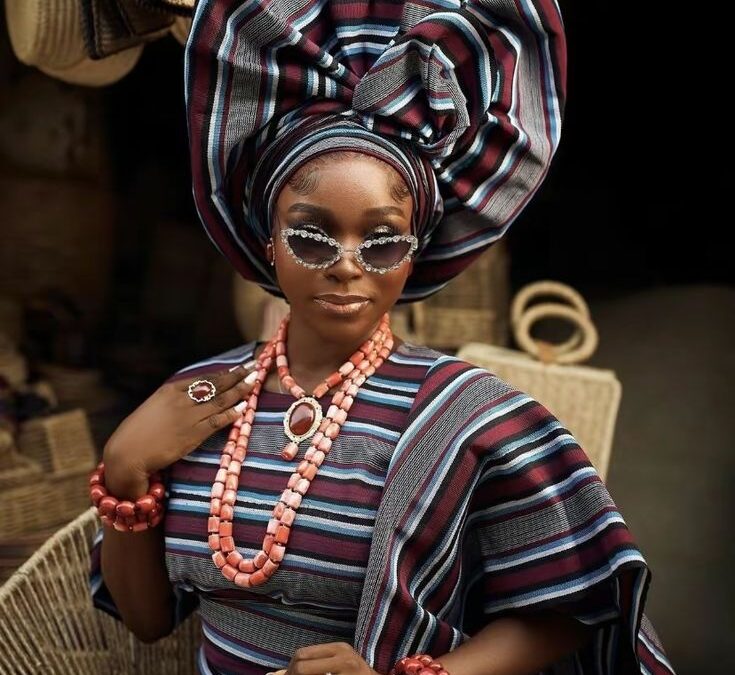
Aso Oke has moved from traditional ceremonies into sneakers, corsets, jackets, trousers and everyday fashion.
For generations, the handwoven textile has represented Yoruba identity, prestige and craftsmanship. Today, younger Nigerians are giving it a new visual language.
The transformation does not mean Aso Oke is losing its cultural meaning. Instead, Gen Z is finding new ways to make heritage fit modern lifestyles.
Aso Oke is increasingly appearing in wardrobes far removed from traditional ceremonies. Its growing presence on social media has also helped younger fashion lovers discover its versatility.

What Exactly Is Aso Oke?
Aso Oke is a traditional handwoven textile associated strongly with the Yoruba people of southwestern Nigeria.
The name is commonly translated as “top cloth.” It is also known as Aṣọ-Òkè or Aṣọ-Ofi.
Unlike factory-produced fabrics, traditional Aso Oke is woven in narrow strips. These strips are later joined to create larger pieces of cloth.
Iseyin in Oyo State is particularly famous for Aso Oke production. The craft is also associated with other Yoruba communities across southwestern Nigeria.
The weaving tradition has a long history in Yorubaland. Historical accounts place the development of cloth weaving in the region centuries ago.
However, specific claims about its exact starting date vary across sources. It is therefore safer to view Aso Oke as a long-established Yoruba weaving tradition.
Traditional weaving requires considerable skill and patience. Artisans work with threads, colours and patterns to create distinctive designs.
The cloth has traditionally been connected with important occasions. These include weddings, naming ceremonies, festivals, funerals and chieftaincy events.
It has also been used for garments such as agbada, buba, iro, gele and fila.
Beyond clothing, Aso Oke has carried social meaning. It can communicate identity, wealth, status, belonging and celebration.
Academic research describes the textile as having significant social, economic and cultural importance among the Yoruba.
Aso Oke is also not one single design.
Some traditional classifications include Alaari, Sanyan and Etu. These varieties have different colours, materials and historical associations.
This variety is part of what makes Aso Oke visually distinctive.
From Wedding Fabric to Modern Fashion
For many Nigerians, Aso Oke was once strongly associated with special occasions.
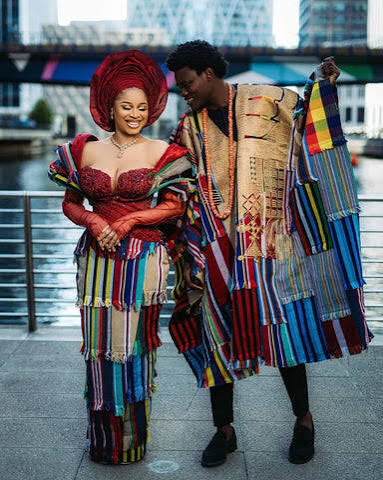
You might see a bride wearing a carefully matched Aso Oke ensemble. The groom might wear a matching agbada and fila.
Family members could also wear coordinated Aso Oke as part of an aso ebi arrangement.
This ceremonial association helped preserve its prestige. However, it also created a limitation.
Younger people sometimes viewed the fabric as something reserved for older generations or major celebrations.
That perception is changing.
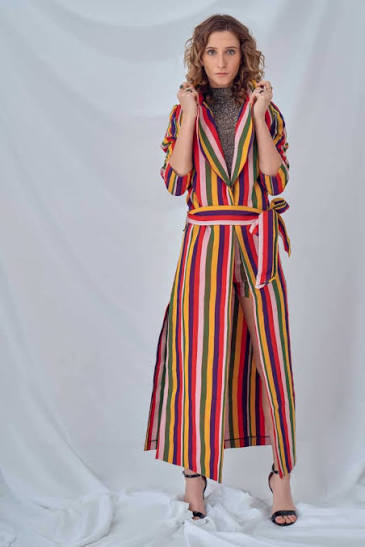
Nigerian designers are now experimenting with lighter weaves, different silhouettes and contemporary combinations.
Aso Oke can now appear as skirts, trousers, blazers, shirts, corsets, dresses, bags and shoes.
It can also be combined with denim, cotton, leather, silk and other modern materials.
This approach makes the fabric easier to wear outside traditional settings.
A young woman might pair an Aso Oke corset with jeans. Another person might wear an Aso Oke jacket with a plain T-shirt.
Someone else might choose an Aso Oke mini skirt with sneakers.
These combinations make the fabric feel less formal without removing its Nigerian identity.
The shift is also visible in contemporary menswear.
Aso Oke can now appear in structured shirts, relaxed trousers, bomber jackets and modern suits.
A 2026 study examining Aso Oke wedding suits in Lagos found strong acceptance of contemporary adaptations. Participants particularly valued uniqueness and cultural expression.
The study also identified familiar challenges. These included perceptions of heaviness, expense and limited accessibility.
Therefore, modernisation is not simply about changing the appearance.
Designers must also make Aso Oke comfortable, practical and accessible to younger consumers.
How Gen Z Is Bringing Aso Oke Back
Gen Z has grown up in a highly visual culture.
Fashion inspiration now moves quickly through TikTok, Instagram, Pinterest and other digital platforms.
A traditional fabric can therefore become a trend when young creators present it differently.
This has happened with Aso Oke.
Social media allows young Nigerians to see the fabric beyond weddings and traditional ceremonies. Fashion creators can demonstrate how to style it with everyday clothing.
Aso Oke has consequently become part of conversations about Nigerian identity and modern African fashion.
One important change is the move towards streetwear.
Designers and young fashion enthusiasts are pairing Aso Oke with sneakers, denim and relaxed silhouettes.
This creates an interesting contrast.
The traditional fabric may represent heritage, while sneakers and oversized clothing represent contemporary youth culture.
Together, they create something that feels Nigerian without looking old-fashioned.
Gen Z is also using Aso Oke through accessories.
Bags, shoes, caps, headbands and smaller fashion pieces allow people to wear the fabric without committing to an entire outfit.
This is particularly useful for young people who want subtle cultural details.
A person might wear a simple black outfit and add an Aso Oke handbag.
Another might choose Aso Oke sneakers with jeans.
These smaller choices make cultural fashion easier to incorporate into everyday life.
There is also a growing interest in gender-neutral styling.
Traditional clothing often had established forms for men and women. Contemporary fashion is becoming more flexible.
Young Nigerians can reinterpret Aso Oke through oversized shirts, trousers, jackets and other silhouettes.
The result is a more experimental relationship with the textile.
Social media has also made cultural fashion more visible internationally.
Nigerian creatives living abroad can wear Aso Oke at parties, fashion events, graduations and cultural celebrations.
Their posts can introduce the textile to audiences who may never have encountered it before.
Why the Aso Oke Revival Matters
The renewed interest in Aso Oke is bigger than fashion.
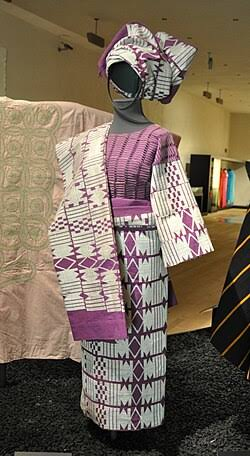
It creates attention for the artisans who produce the fabric.
In Iseyin, weaving remains an important craft and economic activity. Recent reporting shows growing domestic and international demand for Aso Oke.
Supporting authentic Aso Oke can therefore contribute to the survival of traditional weaving skills.
It can also create opportunities for designers, tailors, textile sellers, photographers and fashion entrepreneurs.
However, preserving the culture requires more than simply putting traditional patterns on modern clothes.
Consumers should understand where the fabric comes from. They should also recognise the skill involved in producing genuine handwoven textiles.
Designers have an important role in this process.
They can innovate while respecting the history and craftsmanship behind the material.
Gen Z, meanwhile, can help keep Aso Oke relevant by wearing it in ways that reflect contemporary life.
That may mean a traditional wedding outfit today.
Tomorrow, it could mean an Aso Oke jacket, handbag or pair of sneakers.
This evolution is not necessarily a rejection of tradition.
It shows how culture can survive by adapting to changing lifestyles.
Aso Oke has already travelled from traditional weaving compounds to modern Nigerian wardrobes.
Its next chapter may be shaped by young Nigerians who see heritage as something to wear, create and reinvent.
For Gen Z, Aso Oke does not have to remain locked in the past.
It can be proudly Yoruba, distinctly Nigerian and completely modern at the same time.










Join the conversation